


Truck Bed Tie-Down Systems: How Bed-Mounted Retractable Straps Change Loading
|
Key Takeaways
|
You stop at the hardware store for a few bags of landscape material and leave with lumber and a new tool chest. The truck can carry it. Now you have to secure it, and that means digging a strap out of the toolbox, untangling the webbing, working out which end is which, and repeating the whole routine at every corner. Plenty of people skip the job or rush it because of that friction alone.
Bed-mounted retractable straps change the routine because the strap already lives at the bed, ready to pull out, tension, and retract. Convenience is only part of the story, though. A truck bed tie-down system is an anchor, a strap, and the math that connects them to your load, and the weakest of the three sets the limit. A strong strap on an underrated anchor doesn't give you a strong tie-down point.
What Counts as a Truck Bed Tie-Down System
A truck bed tie-down system is the combination of fixed anchor points in the bed and the straps that connect to them, rated together as one securement system. It has three layers: the anchor (where the strap connects), the strap (webbing, tensioner, and end fittings), and the load math (strap count, direction, and working load limits).
It's easy to shop by the number on the package, on the theory that a bigger number means a stronger setup. But the strap is one piece. Bed liners, cargo nets, bed dividers, and tonneau covers help contain a load; they don't secure it.
The Four Kinds of Bed Anchor
Anchors vary widely in strength even when the hardware looks similar. The table shows published examples, not universal ratings. Check the owner's manual or the maker's rating for your exact anchor and mounting method.
|
Anchor Type |
Published Example |
Drilling |
What It Suits |
|---|---|---|---|
|
Factory cleats and D-rings |
Ford BoxLink: 275 lb between opposed cleats, 600 lb diagonal |
None |
Light to medium everyday loads |
|
Stake-pocket anchors |
Varies by anchor and pocket; use the maker's rating |
None |
Adding tie-down points without drilling |
|
Bolt-in D-rings |
Varies by ring size, bracket, and fasteners; use the rating marked on the product |
Bolts to the bed |
Occasional heavy loads |
|
Track systems (E-track) |
Rhino E-track O-ring anchor: 1,500 lb WLL |
Track bolts to the bed |
Loads that change |
Factory Cleats and D-Rings

Factory anchors are convenient, but they can be rated lower than the strap attached to them. Ford's F-150 owner's manual lists 275 pounds of maximum force between directly opposed BoxLink cleats and 600 pounds between diagonally opposed cleats. Those are forces between a pair of cleats, not a working load limit per cleat, so they limit the strap pair as a whole.
Stake-Pocket Anchors

Stake-pocket anchors add tie-down points with no drilling. Ratings depend on the anchor and the pocket it sits in, so read the maker's published rating and confirm it against your bed before you rely on it.
Bolt-In Universal D-Rings
Bolt-in D-rings offer more flexibility in placement and can carry more, but size matters. Ratings change with the ring, the mounting bracket, and the fasteners, and the surface you bolt to also limits the finished system. Use the working load limit marked on the product, and confirm the bed can take it.
Track Systems: E-Track

Track lets attachment points slide to wherever the cargo sits. Rhino's E-track O-ring anchors are rated 1,500 pounds WLL. Fitting ratings apply to the pull direction the manufacturer specifies, so read the rating for the angle you'll use. For more on the format, see Rhino's guide to E-track systems.
The rule holds across all four: the weakest part of the system sets the limit.
OEM Integrated Systems: BoxLink, RamBox, and the Rest
Truck makers have built cargo control into pickup beds for years. Ratings and configurations change by model year, so treat the table as a map and your owner's manual as the source of record.
|
System |
Interface |
Published Rating |
|---|---|---|
|
Ford BoxLink |
Cleats and mounting points in the bed wall. Rhino's bed-mounted straps fit 2015+ F-150 and 2017+ F-250 with factory BoxLink |
275 lb between opposed cleats; 600 lb between diagonal cleats (Ford F-150 manual) |
|
Ram RamBox bed rail system |
Adjustable sliding cleats on the bed rails, on RamBox-equipped trucks |
250 lb per cleat, with the load angle no more than 45 degrees above horizontal (Ram 2500/3500 manual) |
|
GM stake pockets and bed tie-downs |
Stake-pocket mounting points and fixed bed tie-downs, varying by model |
Set by model, year, and bed; check the owner's manual |
|
Toyota deck rail |
Sliding cleats on Tacoma and Tundra deck rails |
Set by model and year; check the owner's manual |
Ram describes RamBox as a set of lockable storage bins in the bed sides with a cargo rail and sliding cleats, offered as an option on 2009 Dodge Ram Crew 1500 models. For GM and Toyota, we haven't quoted a number because a rating varies by model and bed, and the owner's manual is where it's published. Look yours up before you match a strap to a factory anchor.
Bed-Mounted Retractable Straps: How They Work

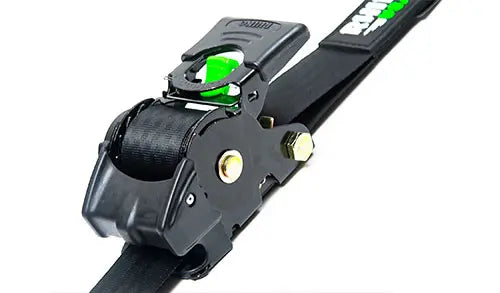
Webbing spools inside a housing that mounts to the bed anchor. You pull the webbing to length, ratchet it to tension, and it retracts back into the housing when you release it. In practice, that means it’s always ready and removable when you need the bed clear.
Rhino USA's Integrated Cargo Magic system for Ford trucks is one example. It mounts to the factory BoxLink points on 2015+ F-150 and 2017+ F-250 trucks, needs no drilling, and swivels 360 degrees. It's backed by Rhino's lifetime replacement program.
There are trade-offs. Retractable straps usually cost more up front, sit in a fixed mounting position, and carry shorter webbing than a loose strap: Rhino's bed-mounted straps are 9 feet, its 2-inch retractables are 10 feet, and its heavy-duty loose straps are 15 feet. Ratings differ too. The 2-inch retractable is rated 1,011 pounds WLL, against 1,666 pounds for the 1.6-inch heavy-duty strap. Check the rating for the exact strap you buy. Oversized or awkward loads are where loose straps still earn their keep.
Rating the System, Not Just the Strap
Break strength, working load limit, and maximum force are not interchangeable. Break strength is the load at which a strap fails. Working load limit (WLL) is the most it's meant to carry in normal use. For synthetic web tie-downs, the industry standard sets a minimum 3:1 design factor (WSTDA T-1), so a strap with 3,300 pounds of break strength gets a WLL of about 1,100 pounds. Rhino's own guide agrees that WLL is generally one-third of breaking strength.
The rating that matters belongs to the assembly. Under 49 CFR 393.108(a), the WLL of a tie-down is the lowest of any of its components, or of the anchor point it attaches to, whichever is less. In plain terms: the biggest number doesn't win; the smallest one does. A strap rated 1,100 pounds clipped to an anchor limited to 275 pounds is a 275-pound tie-down point.
The same federal rules set a target for the whole system. The aggregate WLL of the tie-downs must be at least half the weight of the cargo (49 CFR 393.106(d)). Those rules cover commercial motor vehicles in interstate commerce, generally 10,001 pounds GVWR or more, so they aren't written for the typical pickup load. They're a useful benchmark, and state laws still require you to secure your load.
The rule also says how each strap counts. A strap from a vehicle anchor to the cargo counts half its WLL. A strap that goes over the cargo and returns to the same side counts half. A strap that goes over the cargo to an anchor on the opposite side counts its full WLL.
Here's a worked example. You're hauling a 1,200-pound load. Half is 600 pounds of aggregate WLL. Suppose your bed anchors are limited to 250 pounds, as with a Ram cleat, and your straps run over the load to anchors on both sides. Each strap then counts 250 pounds, whatever the strap itself is rated for. Two straps give 500 pounds, which falls short. Three give 750, which passes, and four give 1,000 with margin and a balanced pattern. Read your own manual for the real anchor number, because Ford states its rating as a force between a pair of cleats, and Ram's assumes a load angle within 45 degrees.
How Many Anchor Points a Bed Needs
Four usable anchor points are a good starting point, since they let you pull against the load from several directions. Rhino's load securement checklist recommends straps in an X pattern to stop tall or top-heavy items from shifting side to side, and its guide to loading dirt bikes into a truck bed recommends at least four tie-downs for a bike. Heavy, long, or awkward cargo may need more, and the federal minimum counts in 49 CFR 393.110 grow with the length and weight of the load.
Think about hard braking, sharp turns, and a bouncy dirt road with coolers and camp gear in the bed. Cargo doesn't only move up and down. Place straps so they control forward, rearward, and side-to-side movement, with a pair near the cab and a pair near the tailgate. Mind the angle too: Ram's 2022 2500/3500 manual limits cleat loads to 45 degrees above horizontal, so keep straps at or below that.
Choosing a System for How You Actually Load
|
How You Use the Bed |
Anchor Type |
Strap Type |
Why |
|---|---|---|---|
|
Daily light loads, similar size each time |
Factory anchors |
Bed-mounted retractables |
Straps are always in place and fast to use |
|
Occasional heavy loads |
Bolt-in D-rings |
Loose ratchet straps |
Higher anchor ratings and longer webbing |
|
Mixed and unpredictable loads |
Track system |
A mix of both |
Anchor points move with the cargo |
|
Powersports in the bed |
Rated anchors |
Dedicated wheel or axle straps plus soft loops |
Protects the machine and its suspension |
Coolers, storage totes, recovery gear, and jobsite tools are good candidates for bed-mounted retractables. Heavy equipment, building materials, and odd shapes may call for stronger anchors and traditional straps. Powersports loads deserve extra care; Rhino's guide to loading dirt bikes into a truck bed covers the tie-down points that work. Whatever the setup, check the anchors, labels, webbing, and routing before you drive, and recheck loads that can settle after the first few miles.
Installing and Maintaining a Bed System

Drilling is permanent, so look at drill-free options first. Ford's BoxLink points, stake-pocket anchors, and Rhino's Integrated Cargo Magic straps need no drilling. If you bolt in D-rings or track, follow the maker's instructions for hardware, torque, and threadlocker.
Keep webbing clean, dry, and out of the sun. WSTDA advises against washing tie-down webbing, because washing can accelerate degradation, and recommends storing it somewhere cool, dry, and dark. On a retractable, brush off grit, let wet webbing air dry before you retract it, and keep the mechanism free of debris. A simple routine helps: pull the strap fully out and look it over before each load, then run through Rhino's load securement checklist before you drive.
Retire webbing that shows the damage WSTDA lists as grounds for removal: holes, tears, cuts or snags, broken or worn stitching, excessive abrasive wear, or signs of UV degradation such as bleaching, stiffness, or surface breakdown. Check the anchors and mounting hardware for looseness, bending, or unusual wear as well. Rhino's guide to using retractable ratchet straps has more on frequent use.
Build the System Around the Way You Use the Truck
Traditional ratchet straps have hauled everything from motorcycles and lumber to camp gear and questionable garage-sale finds, and they aren't going anywhere. Bed-mounted retractable straps just make everyday loading cleaner and faster.
Start with what you actually haul, how heavy it is, and how your truck is equipped. Then weigh the extras: quicker access, less tangled webbing, and a more organized bed. Once you've mapped the system around your real loads, browse Rhino USA's Integrated Cargo Magic collection to find the right fit. Then "that's not going anywhere" can be a statement, not a prayer.
FAQs
How much weight can truck bed tie-down anchors hold?
There's no universal rating. Capacity depends on the truck, anchor design, installation, and pull direction. Ford rates BoxLink at 275 pounds between opposed cleats and 600 diagonally, and Ram rates its bed rail cleats at 250 pounds each. Check the owner's manual or the anchor maker's published rating.
Are bed-mounted retractable straps worth it?
For frequent haulers, yes. Retractable straps give you a cleaner setup, faster breakdown, and no tangled webbing, and they store without coiling. They make less sense for occasional or oversized loads, where traditional ratchet straps cost less and offer longer webbing. Match the setup to how often you haul.
What is the Ford BoxLink system?
BoxLink is Ford's factory cleat system in the bed walls of its F-Series pickups. Ford rates it at up to 275 pounds of force between opposed cleats and 600 pounds between diagonal cleats. Rhino's Integrated Cargo Magic straps mount at BoxLink points on 2015+ F-150 and 2017+ F-250 trucks with no drilling.
How many tie-down points do I need in a truck bed?
Four is a common starting point, because it lets you pull against the load from several directions in an X pattern. Heavy, long, or top-heavy cargo may need more. Federal rules set minimum tie-down counts by length and weight, and every anchor still needs a rating that matches the load.
Is the working load limit one third of break strength?
For synthetic web tie-downs built to a 3:1 design factor, WLL is generally one-third of the strap's break strength. Some sources quote lower ratios for other materials or products. Always use the WLL marked on the strap, and remember the anchor may set a lower limit.
Do truck bed tie-downs require drilling?
Not always. Factory cleats such as Ford BoxLink, stake-pocket anchors, and Rhino's Integrated Cargo Magic straps can be installed with no drilling. Bolt-in D-rings and track systems mount with hardware to the bed, so plan on fasteners and follow the manufacturer's installation instructions.
How much cargo weight can my straps legally secure?
No single limit applies to every pickup, and state laws require you to secure your load. As a benchmark, federal commercial rules require the combined WLL of all tie-downs to equal at least half the cargo weight, with the anchors counted. For example, 600 pounds of aggregate WLL secures 1,200 pounds.
- Choosing a selection results in a full page refresh.