


Retractable ratchet straps and regular ratchet straps look the same in the back of the truck, but they solve two different problems. Retractables eliminate the loose-webbing mess of every load. Regular ratchets give you maximum tension at the lowest price. The right pick depends on how often you haul and what you're hauling.
This guide is the straight comparison: retractable vs standard ratchet straps, the full family of ratchet strap types most buyers confuse, when to use each, who each one is best for, key setup differences, why retractables cost more, and the common buying mistakes that lead to returns. By the end, you'll know exactly which strap belongs in your truck.
Which Strap Is Right for You?
Three questions to get to the answer in 30 seconds.
1. How often do you haul?
- A few times a year (occasional): Standard ratchet straps. Lower price point, plenty of capacity.
- Multiple times a week (frequent): Retractable ratchet straps. The time and clutter savings pay back fast.
2. What are you hauling?
- Motorcycles, ATVs, UTVs in a trailer: Retractable or standard 2" ratchets, plus Motorcycle Soft Loops at the frame contact points.
- Lumber, appliances, project loads in a pickup bed: Retractable ratchet straps. The faster setup matters when you're loading at a job site.
- Boat on a trailer: Retractable Transom Tie-Down Straps.
- Enclosed trailer with E-track rails: Retractable E-Track Ratchet Straps or Standard E-Track Ratchet Straps.
- Ford pickup bed (F-150, F-250, F-350): Bed-Mounted Retractable Ratchet Straps for Ford Trucks install directly into the factory tie-down points.
3. How much do you want to spend?
Retractable straps cost more than standard ratchets. The mechanism is more complex, the housing is heavier-duty, and the manufacturing is more involved. For occasional use, the standard ratchet is the right call. For frequent use, the retractable pays for itself.
The Full Ratchet Strap Family: Side-by-Side Comparison
Most buyers get retractables vs standard ratchets right but get confused by the rest of the family. Here is the complete comparison.
| Feature |
 Standard Tie-Downs Standard Tie-Downs |
 E-Track Tie-Downs E-Track Tie-Downs |
 Retractable E-Track Retractable E-Track |
 Retractable Transom Retractable Transom |
 Retractable Ratchet Retractable Ratchet |
|---|---|---|---|---|---|
| Best For | General hauling | Trailer wall systems | Enclosed trailer setups | Boat + trailer transport | Truck bed + frequent use |
| Fast Setup | Moderate | Moderate | Yes | Yes | Yes |
| Easy Storage | No (manual coil) | Moderate | Yes | Yes | Yes |
| Loose Strap Management | Manual | Manual | Auto-retract | Auto-retract | Auto-retract |
| Frequent Use Convenience | Moderate | Strong | Very Strong | Strong | Very Strong |
| Trailer-Specific Use | Moderate | Yes (E-track rail required) | Yes (E-track rail required) | Specialized (boat trailer) | Universal |
| Boat-Specific Use | No | No | No | Yes | No |
| Lowest Price Point | Yes | Moderate | No | Moderate | Moderate to High |
Retractable Ratchet Straps

What Makes Retractables Different
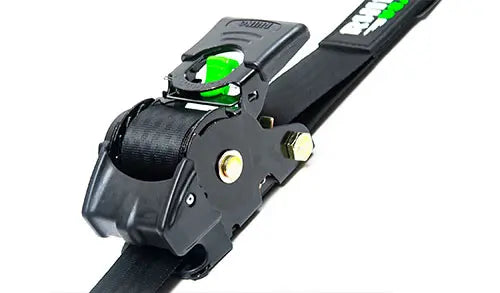
- Auto-retracting webbing wound into a spring-loaded housing
- No loose strap to manage during or after the haul
- Faster setup, faster breakdown
- Cleaner storage in the truck bed, trailer, or toolbox
- Less frustration on every load
- Ideal for frequent hauling
Best For
- ATVs, UTVs, motorcycles, dirt bikes
- Lawn equipment
- Truck-bed cargo for frequent haulers
- Trailers (open or enclosed)
- Customers who want fast setup and zero strap clutter
Not Ideal For
- Ultra-heavy commercial hauling that exceeds the 1,209 lb (1") or 3,033 lb (2") break strength
- Long-trailer cargo runs that require more than 10 to 12 feet of webbing
- Setups that require specialty end fittings (J-hooks, E-track clips, D-rings) not offered in the retractable lineup
- Buyers on the strictest budget who haul once or twice a year
Rhino USA Retractable Lineup
- 1" x 10' Retractable Ratchet Straps: 1,209 lb break strength. Motorcycles, kayaks, lighter ATVs, general cargo.
- 2" x 10' Retractable Ratchet Straps: 3,033 lb break strength. UTVs, heavier ATVs, appliances, vehicle securement.
- 2" x 10' Retractable E-Track Ratchet Straps: 3,033 lb for enclosed trailers with E-track rails.
- 2" x 43" Retractable Transom Tie-Down Straps (2-Pack): 1,800 lb break strength. Boat trailers.
- Bed-Mounted Retractable Ratchet Straps for Ford Trucks (Ford F-150 2015+, and F-250/F-350/F-450 2017+): 1" 1,200 lb break strength, and 2" 3,033 lb break strength. Mounts directly to factory BoxLink points, no drilling required.
Soft loops are included with every Rhino USA retractable strap. Use them at every painted contact point.
Standard Ratchet Straps

What Makes Standard Ratchets Different
- Traditional heavy-duty ratchet mechanism
- Manual strap management (coil the loose end after each haul)
- More flexibility across load types and anchor styles
- Budget-friendly entry point
- The right pick for customers who prefer the traditional ratchet feel and don't mind managing the loose webbing
Best For
- Heavy-duty hauling where maximum tension is the priority
- Trailers and equipment transport
- Larger or commercial loads
- Customers prioritizing strength and flexibility over setup speed
- Occasional haulers who don't haul every week
Not Ideal For
- Frequent haulers who want the fastest possible setup
- Customers who hate dealing with tangled strap storage
- Buyers who want the cleanest truck-bed or trailer look
Rhino USA Standard Lineup
- 4pk Ratchet Tie-Down Kit: our most popular four-pack. Polyester webbing, forged hooks, reinforced stitching.
- 1.6" x 15' HD Ratchet Tie-Down Set 4-Pack: heavy 5,000 lb break strength, carrying bag included.
- Self-Tensioning Ratchet Straps: spring-tensioned standard straps that maintain consistent load as cargo settles.
- Cambuckle Tie-Down Straps: quick on/off for medium loads.
Key Setup Differences
Three real-world differences between retractables and standard ratchets that show up on every haul.
1. Pulling Strap to Length
- Retractables. Pull the webbing out of the housing to the length you need. Tension automatically engages when you release.
- Standard. Thread the loose end through the ratchet, take up slack by hand, then crank to tension. More steps.
2. Breakdown
- Retractables. Release the ratchet, the webbing retracts automatically. You're done.
- Standard. Release the ratchet, the loose webbing falls to the ground. Coil it by hand to store cleanly.
3. Storage Footprint
- Retractables. The housing keeps the strap compact. Stack four or six retractables in a small bin.
- Standard. Loose straps pile up. Without a storage bag, they tangle into a mess.
Why Retractable Ratchet Straps Cost More
Three reasons.
- More complex mechanism. A spring-loaded retraction housing has more moving parts than a basic ratchet.
- Heavier-duty housing. The spring tension requires a stronger housing to contain the wound-up webbing.
- Manufacturing cost. More parts, tighter tolerances, more assembly steps.
The upfront premium pays back fast for frequent haulers. The time saved on every load adds up across a season.
Common Buying Mistakes to Avoid
Five mistakes that lead to returns.
1. Buying for the wrong frequency
If you haul once a year, retractables are overkill. If you haul every weekend, standard ratchets feel like a downgrade after a single retractable load. Match the strap type to your actual use frequency.
2. Buying the wrong width
A 1" wide strap can't safely lock down a 2,500 lb UTV. A 2" wide strap is overkill for a kayak on a roof rack. Match the width to your load weight and anchor points.
3. Ignoring the anchor type
Stake pockets, D-rings, E-track rails, frame tubes. Each anchor style needs a different hook fitting. Match the hook style to the anchor before you buy.
4. Skipping soft loops on painted parts
Steel hooks on painted frame tubes scratch every time. Soft loops protect paint and anodized finishes. Plan for soft loops at every painted contact point.
5. Buying gas-station straps for permanent use
Cheap straps from a gas station or big-box store have stamped sheet-metal hooks that bend and break, polypropylene webbing that fades and frays in months, and no warranty. Rhino USA straps are polyester webbing, forged steel hooks, and lifetime warranty.

Axle Straps: The Right Anchor Point for UTV and SxS Hauling
For UTVs and side-by-sides, the recommended setup is to pair retractable straps with axle straps rather than hooking directly to the chassis. Axle straps route around the front and rear axles and give the retractables a solid anchor point that works with the suspension instead of against it. Grab a set of Soft Loop Tie-Downs for any painted contact points and you've got a clean, suspension-friendly four-point setup.
Soft Loops: The Most Affordable Paint-Protection Upgrade
For motorcycles, UTVs, ATVs, or any vehicle with painted parts, soft loops are essential. They wrap around frame tubes and provide a soft connection point for ratchet hooks. The Motorcycle Soft Loops cover most setups.

How to Use Retractable Ratchet Straps
- Pull the webbing out of the housing to the length you need.
- Hook the end fitting to the anchor on your vehicle or trailer.
- Pull the strap into position over the cargo.
- Hook the housing end to the second anchor point.
- Crank the ratchet handle to apply tension. The auto-retract eliminates loose webbing.
- Lock the ratchet by closing the handle into the locked position.
To release: pull the release lever and pivot the ratchet handle fully open. The webbing retracts into the housing automatically.

How to Use Standard Ratchet Straps
- Pull the release lever fully open.
- Thread the strap through the slot in the ratchet.
- Pull the slack out to remove the gap.
- Crank the ratchet handle up and down to apply tension.
- Lock the ratchet by closing the handle into the locked position.
- Stow the loose end so it doesn't flap during transport (roll, loop, or bag method).
For deeper coverage, see How to Thread, Use, and Release a Ratchet Strap.

FAQ
Retractable vs standard ratchet straps: which is better?
Neither is universally better. Retractables are better for frequent haulers who want fast setup and clean storage. Standard ratchets are better for occasional haulers or buyers on the tightest budget.
When should I use retractable ratchet straps?
When you haul often, when you want zero strap management, or when you need the cleanest possible setup in a truck bed or trailer.
When should I use standard ratchet straps?
When you haul occasionally, when you need maximum tension on heavy cargo, or when budget is the deciding factor.
Who is each ratchet strap best for?
Retractables for frequent haulers, ATV/UTV owners, motorcycle haulers, truck-bed users. Standard ratchets for occasional haulers, commercial-style hauling, or budget buyers.
What are the key setup differences between retractable and standard ratchet straps?
Retractables auto-retract excess webbing. Standard ratchets require manual coil. Retractables are faster to set up and break down. Standard ratchets have more flexibility for unusual anchor configurations.
Why do retractable ratchet straps cost more than standard?
More complex mechanism, heavier-duty housing for the spring tension, more parts and assembly steps. The upfront premium pays back fast for frequent haulers.
What are the common buying mistakes with ratchet straps?
Buying for the wrong frequency, wrong width, ignoring anchor type, skipping soft loops on painted parts, and buying cheap gas-station straps for permanent use.
Are retractable ratchet straps strong enough for heavy cargo?
Yes for most recreational and utility loads. Rhino USA 1" retractables have a 1,209 lb break strength and the 2" version hits 3,033 lbs. For ultra-heavy commercial hauling that pushes past those numbers, traditional heavy-duty straps with 5,000+ lb break strength are the right tool.
What is the disadvantage of retractable ratchet straps?
Three honest disadvantages: they cost more upfront, max webbing length is around 10 to 12 feet, and the internal mechanism can jam if debris gets into the housing. The debris issue is manageable. Rinse after muddy use and store in a bag. The length and cost are real tradeoffs worth knowing.
How long do retractable ratchet straps last?
With normal use and basic maintenance, five or more years. The webbing is typically the first thing to show wear, so inspect before every use. Rhino USA backs every strap with a lifetime replacement warranty. If a mechanism or webbing fails, we replace it.
Can you use retractable straps for motorcycles?
Yes. The 1" width with 1,209 lb break strength is more than sufficient for any motorcycle. Always use soft loops at every contact point to protect the bike's finish and avoid hooking directly to any suspension components.
What size retractable ratchet strap do I need?
1" straps (1,209 lb break strength) are right for motorcycles, lighter ATVs, kayaks, bikes, and general cargo under 400 lbs per strap. 2" straps (3,033 lb break strength) are the choice for UTVs, heavier ATVs, appliances, and anything where you want more holding power. When in doubt, size up.
Can retractable ratchet straps replace regular ratchet straps?
For most use cases, yes. The exception is ultra-heavy commercial hauling where the highest absolute tension matters more than setup convenience.
What's the difference between E-track ratchet straps and retractable E-track ratchet straps?
Both use E-track fittings to lock into a trailer's E-track rail. The retractable version auto-retracts excess webbing into the housing for a cleaner setup.
Are E-track ratchet straps the same as retractable ratchet straps?
No. E-track straps clip into trailer rail systems and do not auto-retract. Retractable ratchet straps have a spring-loaded housing that winds the webbing automatically and use standard S-hooks for universal anchor points.
Which ratchet straps are best for trailers vs boats?
For trailers, retractable ratchet straps or standard 2" ratchets depending on use frequency. For boats on trailers, Retractable Transom Tie-Down Straps are purpose-built.
Are transom straps the same as retractable ratchet straps?
No. Transom straps are purpose-built for securing boats to trailers, with a max strap length of 43 inches. Retractable ratchet straps are general-purpose cargo straps for trucks, trailers, and vehicle transport.
Are Rhino USA retractable ratchet straps worth the upgrade?
For frequent haulers, yes. The time saved on every load and the cleaner storage pay back fast. Backed by lifetime warranty.
Are Rhino USA ratchet straps made in the USA?
Rhino USA is an American family-owned company headquartered in California with offices in Murrieta, Austin, and Woodstock. Products are also available at retail through Walmart in addition to rhinousainc.com and Amazon.
Related Articles
- 5 Reasons Retractable Ratchet Straps Are Worth the Investment
- How to Properly Maintain and Store Your Retractable Ratchet Straps
- How to Thread, Use, and Release a Ratchet Strap
- How to Tie Down a Motorcycle
- How to Properly Use Soft Loop Tie-Down Straps
- How to Strap Down a Refrigerator on a Trailer
- How to Set Up E-Track for Trailers