

Knowing how to tie up a boat properly is the single biggest skill that separates a smooth day on the water from a damaged hull, a snapped line, or a runaway boat. There are two scenarios most owners face: tying up at a dock, and securing the boat on a trailer. Both matter. Both have right ways and wrong ways. Both go bad fast when done sloppy.
This is the no-fluff guide to both. The dock side covers cleat hitches, bowlines, spring lines, fender placement, and tide and wake. The trailer side covers bow winch strap to the front, transom straps to the stern, and why both are needed. Plus dock-line sizing, line types, knot basics, and the common mistakes that lose boats. Every Rhino USA dock line and tie-down is American owned, family operated, and backed by our lifetime warranty.

Two Scenarios: Dock and Trailer
Tying up a boat means two different things depending on where the boat is.
At a dock, you are tying the boat to a fixed point so it stays alongside without drifting, banging, or getting away. Lines run from cleats on the boat to cleats or pilings on the dock. Fenders protect the hull. Spring lines control fore-and-aft movement.
On a trailer, you are tying the boat to the trailer for transport. A winch strap pulls the bow tight against the bow stop. Transom straps lock the stern. Both ends are needed.
How to Tie Up a Boat at a Dock
The dock setup uses three to four lines: bow line, stern line, and one or two spring lines. Each does a specific job.
Step 1: Hang the Fenders
Before the boat touches the dock, drop fenders over the side that will face the dock. Three fenders for most boats up to 25 ft. Four or more for larger boats. Position at the widest beam point and at bow and stern where the hull would otherwise contact the dock.
Skip fenders and the gel coat takes the hit on every wave.
Step 2: Get the Bow Line On First
The bow line runs from a bow cleat on the boat to a cleat or piling on the dock. Tie the bow first because it swings further than the stern in current or wind. Run the line to a cleat slightly ahead of the bow at about 30 to 45 degrees forward. This holds the bow and prevents drifting back.
Step 3: Stern Line Next
Mirror the bow line. Run from a stern cleat on the boat to a dock cleat slightly aft of the stern, at 30 to 45 degrees. This holds the stern and prevents drifting forward.
With bow and stern lines set, the boat is held alongside but can still slide fore and aft. Spring lines fix that.
Step 4: Spring Lines for Fore-Aft Control
Spring lines prevent the boat from sliding along the dock.
- Forward spring runs from a midship or bow cleat on the boat to a cleat on the dock toward the stern. Prevents drifting forward.
- Aft spring runs from a midship or stern cleat to a cleat toward the bow. Prevents drifting backward.
One spring line covers a short stop. For longer stays, run both.
Step 5: Cleat Hitch the Lines
Tie each line off with a cleat hitch on the dock side:
- Wrap once around the base of the cleat.
- Cross over the top to the opposite horn in a figure-eight.
- Repeat the figure-eight once or twice.
- Finish with a half hitch under the last horn.
- Pull tight.
Done right, the cleat hitch holds under load and unties cleanly. Avoid wrapping with simple turns and tying random knots. Those bind under load.
Step 6: Account for Tide and Wake
In tidal water, a tight line at low tide becomes slack at high tide (or vice versa). For overnight or longer stays, use longer lines and tie with slack to allow for tidal range.
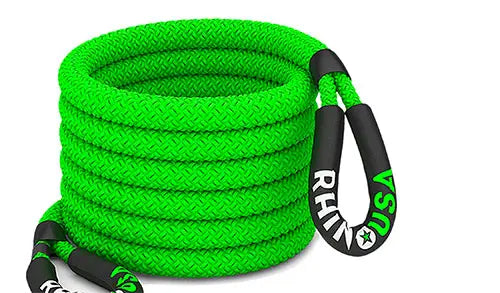
The Heavy-Duty Bungee Dock Lines absorb wake, tide changes, and surge that would otherwise yank standard nylon lines. Useful in busy harbors, tidal docks, and rough weather.

Dock Line Sizing by Boat Length
Match line diameter to boat length. Too thin and the line snaps under load. Too thick and the line is hard to handle and does not grip cleats well.
- Boats up to 20 ft: 3/8 inch diameter dock lines, 15 to 20 ft length each.
- Boats 20 to 30 ft: 1/2 inch diameter dock lines, 20 to 25 ft length each.
- Boats 30 to 40 ft: 5/8 inch diameter dock lines, 25 to 30 ft length each.
- Boats over 40 ft: 3/4 inch diameter or larger, 30 ft or longer.
For most recreational boats in the 18 to 25 ft range, the Heavy-Duty 16' Dock Lines (1/2") are the right size. Buy four (one bow, one stern, two springs).
Length should be roughly equal to or slightly longer than the boat. Lines too short force tight angles that shock-load cleats.

Dock Line Types: Standard vs Bungee
Standard nylon dock lines are the workhorse. Three-strand or double-braid nylon stretches slightly under load to absorb shock from wake and gusts. The Heavy-Duty 16' Dock Lines are double-braid nylon with straight-cut ends for custom knot configurations.
Bungee dock lines have an integrated elastic core inside the outer braid. The core stretches to absorb wake, tide, and surge. The nylon braid prevents over-stretching. Useful in busy harbors, tidal water, storm conditions, and long-term moorage. For day-trip dockings in calm water, standard nylon is fine. For overnight or longer stays in active water, bungee lines pay off.

Knot Basics: Cleat Hitch and Bowline
Two knots cover 95 percent of dock line use. The cleat hitch (already covered above) ties a line to a cleat: wrap, figure-eight, figure-eight, half-hitch finish.
The bowline creates a fixed loop for dropping over a piling or cleat that does not have a horn:
- Form a small loop a few feet from the working end.
- Pass the working end up through the loop from below.
- Around the standing line.
- Back down through the loop.
- Pull tight.
The "rabbit comes out of the hole, around the tree, back down the hole" shortcut covers it. The bowline holds firm under load and unties easily.

How to Secure a Boat on a Trailer
Different scenario, different gear, same goal: hold the boat in place.
Step 1: Float the Boat Onto the Trailer
Back the trailer down the launch ramp until the bunks or rollers are submerged enough for the boat to float on. Drive or walk the boat onto the trailer until the bow contacts the bow stop.
Step 2: Attach the Bow to the Winch Strap
Hook the snap hook on the Boat Winch Strap with Hook into the bow eye. Crank the winch handle to pull the strap tight. The bow should be firm against the bow stop with no rocking.
If the winch itself is worn (rusty, hard to crank, slipping under load), replace it with a Heavy-Duty Boat Trailer Winch before the next trip.
Lock the winch handle in the locked position. The bow strap holds the bow.
Step 3: Set the Transom Straps
The bow strap alone is not enough. The stern still needs to be locked to the trailer. Use transom straps:
- The Transom Tie-Down Set is two 2" x 4' ratcheting transom straps for the rear corners.
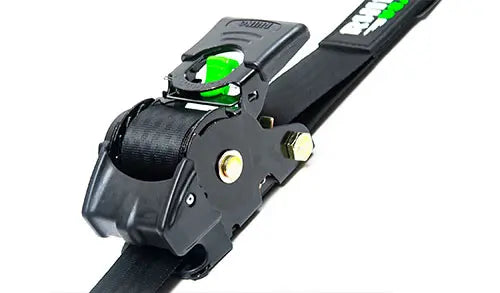
- The 2" x 43" Retractable Transom Tie-Down Straps (2-Pack) is the retractable version. Cleaner setup with no loose webbing flapping at highway speed.
Run each transom strap from a stern eye or transom anchor on the boat to a fixed point on the trailer (D-ring, eye bolt, or stake pocket on the rear cross-member). Tighten until the stern is firm against the trailer bunks with no rocking.
Step 4: Ratchet vs Cam Buckle Tension
Two tension styles for transom straps.
- Ratchet straps apply heavy tension via a ratchet mechanism. The right pick for highway transport, longer trips, or larger boats.
- Cam buckle straps apply moderate tension via a spring-loaded cam. Faster on and off but lower tension. Useful for shorter local trips or lighter boats.
For most owners hauling longer than a few miles, ratchet-style transom straps are the right call. Cam buckles work for short hops to the local ramp.
Step 5: Verify Before Driving
Walk around the trailer and check:
- Bow strap tight, winch handle locked
- Transom straps tight, ratchets locked
- Bow firm against bow stop
- Stern firm against bunks or rollers
- Any loose gear in the boat secured (anchors, coolers, lines)
- Trailer lights, brakes, and hitch verified
That is the full trailer setup.

Common Mistakes Tying Up a Boat
Lines too short. A short line forces a tight angle to the cleat, shock-loading on every surge. Use lines equal to or longer than the boat length.
No fenders. A boat against a dock with no fenders rubs gel coat off in minutes. Three fenders minimum for boats up to 25 ft.
Only the bow strap on the trailer. The winch strap holds the bow. Transom straps hold the stern. Use both.
Wrong knots. A loose granny knot at a cleat unties under load. Practice the cleat hitch and bowline in the driveway before you need them.
Ignoring tide and wake. A tight line at low tide pulls cleats out at high tide. In high-traffic harbors, use bungee lines or extra slack.
Skipping spring lines on long stays. A boat with only bow and stern lines slides forward and back with every wake. Run at least one spring line for any stay over a few hours.

Top Picks: Rhino USA Lines and Tie-Downs for Tying Up Your Boat
The full kit for dock and trailer.
Heavy-Duty 16' Dock Lines (1/2")
Double-braid nylon dock lines with eye splices. The right size for most 18 to 25 ft boats. Buy four for a full bow, stern, and two-spring setup. Lifetime warranty.
Heavy-Duty Bungee Dock Lines
Integrated bungee core absorbs wake, tide, and surge. The right call for tidal docks, busy harbors, and overnight stays. Lifetime warranty.
Boat Winch Strap with Hook
2" x 20' polyester replacement strap with chromoly J-hook with safety clip. Works with most factory and aftermarket winches. Lifetime warranty.
Heavy-Duty Boat Trailer Winch
Dual-speed manual winch with corrosion-resistant finish. Direct-fit upgrade for most standard winch posts. Lifetime warranty.
Transom Tie-Down Set
Two 2" x 4' ratcheting transom straps for the stern. The other half of a complete trailer tie-down setup. Lifetime warranty.
2" x 43" Retractable Transom Tie-Down Straps (2-Pack)
Retractable transom straps for owners who haul often. Auto-retract eliminates loose webbing and storage-box tangles. Lifetime warranty.

Why Rhino USA Boat Lines and Tie-Downs
Rhino USA is American owned, family operated, headquartered in California. Every dock line, winch strap, and transom strap carries a lifetime warranty. If a product ever fails under normal use, we replace it. Real reviews on every product page run in the thousands at high ratings, real reviews from real boaters, not paid placements. Heavy-duty nylon on every dock line, polyester webbing on every trailer strap. Phone-answered customer service. Built for owners who use the gear for real.
FAQ
How do you tie up a boat at a dock?
Hang fenders, run a bow line forward at 30 to 45 degrees, run a stern line aft at the same angle, and add one or two spring lines for fore-aft control. Tie each line with a cleat hitch.
What knots do I need to tie up a boat?
The cleat hitch and the bowline cover almost everything. The cleat hitch ties a line to a cleat. The bowline creates a fixed loop for dropping over a piling.
How long should dock lines be?
Roughly equal to or slightly longer than the boat. For boats 18 to 25 ft, 16 to 20 ft lines work. Larger boats need 25 to 30 ft.
What size dock line do I need?
3/8 inch for boats up to 20 ft, 1/2 inch for 20 to 30 ft, 5/8 inch for 30 to 40 ft, 3/4 inch for over 40 ft.
How many dock lines do I need?
Four minimum: bow, stern, and two spring lines. For longer stays or rough conditions, six lines.
Standard dock lines or bungee dock lines?
Standard nylon for short stays in calm water. Bungee for tidal water, busy harbors, overnight stays, or storm conditions.
How do I tie a cleat hitch?
Wrap once around the base of the cleat, cross over the top in a figure-eight, repeat once or twice, finish with a half-hitch.
What are spring lines?
Lines that prevent fore-aft sliding along a dock. Forward spring runs from a midship cleat on the boat to a stern-side cleat on the dock. Aft spring runs to a bow-side cleat.
How do I tie up a boat on a trailer?
Pull the boat tight against the bow stop with the winch strap. Run two transom straps from the stern to fixed points on the trailer. Tighten, lock, verify.
Do I need transom straps if I have a winch strap?
Yes. The winch strap holds the bow. Transom straps hold the stern. Skip the transom straps and the stern bounces on every bump.
Ratchet straps or cam buckles for transom straps?
Ratchet for highway transport. Cam buckle for short local hops.
How tight should transom straps be?
Tight enough to seat the stern firmly on the bunks with no rocking. Do not over-tighten.
What is the bow eye on a boat?
A fixed metal ring or U-bolt at the very front of the hull, designed to accept the winch strap hook.
Can I use ratchet straps as dock lines?
No. Dock lines need to stretch slightly under load to absorb wave shock. Ratchet straps do not stretch.
What is the best dock line material?
Double-braid nylon for most uses. Three-strand for abrasion resistance. Bungee for shock absorption in active water.
How do I prevent dock line chafe?
Use chafe guards where the line passes over the dock edge or chock. Inspect for fraying after every long stay.
How do I tie up a boat in a slip?
Four lines minimum: bow, stern, and two springs. With pilings on both sides, run port and starboard for full security.
Are bungee dock lines worth it?
For tidal water, busy harbors, or overnight stays, yes. For calm short-stay docking, standard nylon is fine.
How long should a boat winch strap be?
For boats 18 to 22 ft, 20 ft is standard. Larger boats need 25 ft or more.
What is the most common mistake tying up a boat?
Skipping fenders at the dock. On a trailer, the most common mistake is using only the bow strap with no transom straps.
How tight should the bow strap be on a trailer?
Tight enough that the bow is firm against the bow stop with no rocking.
What is the warranty on Rhino USA dock lines and tie-downs?
Lifetime warranty across the lineup. If a product ever fails under normal use, we replace it. American owned, family operated.
Related Articles
- Best Boat Trailer Winch: 2026 Buyer's Guide
- Boat Trailer Winch Strap: Replacement Guide & Best Picks
- 10 Things to Check Before You Tow
- Retractable vs Traditional Ratchet Straps