



Most pre-trip checklists forget the three things thieves — and physics — are counting on you to skip. Run through all ten of these before you pull out of the driveway, every single time.
Before towing, check your hitch ball and mount, verify tow vehicle weight ratings, inspect trailer tire pressure and condition, test all trailer lights, confirm safety chains are properly crossed, secure cargo with rated straps, block your wheels with chocks, lock your hitch receiver with a keyed pin, close the coupler with a coupler lock, then do a slow rolling check before the highway.
Items 7–9 — wheel chocks, hitch pin, coupler lock — form a three-point trailer security system that most people skip entirely. With trailer theft trending up in 2026, those three steps take five minutes and close every common vulnerability.
You've loaded the gear, hitched the trailer, done the mirror check. It feels like you're ready. But towing is one of those situations where a skipped step doesn't just cost you time — it can cost you a trailer, a load, or worse. We put together this list for anyone who wants to pull out of the driveway confident they covered everything.
A few of these are mechanical basics you probably already run through on autopilot. A few — especially items 7 through 9 — are ones most people haven't built into their routine yet. Trailer theft has been trending up heading into 2026, and the campsite or trailhead is where it most often happens. The fix isn't complicated. It's just a system, and it takes about five minutes once you have the right gear.
The Full Pre-Trip Checklist
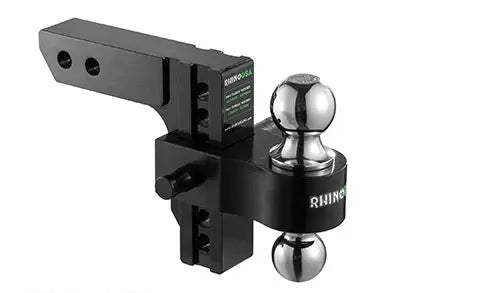
Check that your hitch ball matches your coupler rating — 1-7/8", 2", and 2-5/16" are not interchangeable. Make sure the ball nut is torqued to spec and the mount isn't corroded or cracked. A loose ball is the kind of failure that feels fine right up until it isn't.
Know your gross vehicle weight rating (GVWR) and your tow vehicle's max tow capacity — and don't fudge the math. Your trailer weight plus the load needs to stay under both numbers. Overloading doesn't just strain your engine; it compromises your brakes and your ability to stop in an emergency.
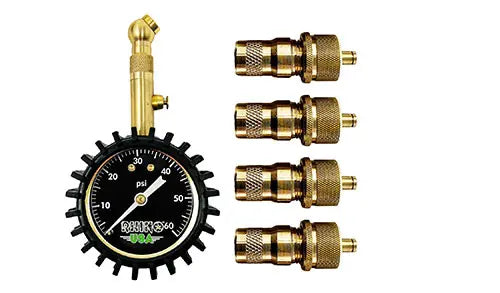
Trailer tires sit for weeks between trips and lose pressure faster than vehicle tires. Check PSI cold, before you move the rig. While you're down there, look at tread depth and sidewall for dry rot — trailer tires have a shorter lifespan than most people think, even when they still look fine.
Running lights, brake lights, turn signals, hazards. Have someone stand behind the trailer while you run through the sequence. Corroded 7-pin connectors are the usual culprit when lights fail — keep a spare connector in your kit. Lights aren't optional; they're the law, and they're what keeps someone from rear-ending your rig at 65 mph.
Cross your safety chains under the tongue in an X pattern — this creates a cradle that catches the tongue if the coupler separates. Chains should have just enough slack to allow turns without dragging. Check for wear and make sure the hooks actually engage; a chain that's clipped to itself is decorative, not functional.
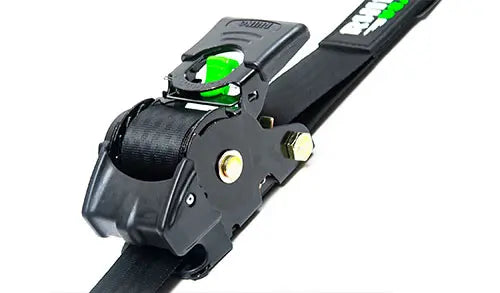
Keep 60% of your load weight in front of the axle for proper tongue weight. Everything on the deck should be secured — straps rated for the load, anchored at multiple points, snugged down with no vertical bounce. One unsecured corner flapping at highway speed turns a strap into a sail, and a sail into a liability.
Everything starts here. The moment your trailer disconnects from the vehicle, it's on its own. Rubber wheel chocks at the front and rear of both trailer tires prevent roll on any grade — including grades that feel completely flat. It takes about 30 seconds. It's the first step of the ritual.
Trailer theft is trending up. Most of it happens fast and in the dark, and most of it happens because the connection point was open. A locking hitch pin — keyed, not just a clip — turns your receiver into a hard target. Thieves are looking for the path of least resistance. This closes that path.
Here's the one most people skip. Even with a locked hitch pin, a trailer with an open coupler can be re-hitched to another vehicle. A coupler lock blocks the ball socket entirely — no ball connects without your key. Chocks. Pin. Coupler. That's the full sequence. That's what it looks like when you lock it down from every angle.
Before you hit the highway, roll slowly through a parking lot or down your street. Apply the brakes. Listen for anything shifting or rattling. Check your mirrors for trailer sway. It takes two minutes and it catches problems that a stationary check will miss every time.
"Buying one lock is reactive. Running all three is a system — and a system is what keeps your trailer exactly where you left it."
Items 7, 8, and 9 are where most people have a gap — not because they don't care about their gear, but because trailer security hasn't felt urgent enough to build into the routine. That's changing. Trailer theft is trending up, and the stories are consistent: campsite, boat launch, trailhead parking lot, overnight. Fast and quiet, and almost always at one of those three open points.
The answer isn't hypervigilance. It's just closing the gaps before you walk away — chocks down, pin locked, coupler closed. Five minutes. Every time.
Most people secure one point. This covers all three. It starts on the ground with wheel chocks — nothing rolls the moment you disconnect. Then the hitch pin locks your receiver, so nothing connects without your key. Then the coupler lock closes the final gap — they can't hook up and drive off, period. Three layers. Zero gaps. Backed for life.
- Heavy-Duty Rubber Wheel Chocks — it starts on the ground
- Locking Trailer Hitch Pin (2") — nothing connects without your key
- Trailer Coupler Lock Kit — closes the final gap
A Note on Frequency
Run this checklist every single trip, not just the first one of the season. Bolts back off. Tire pressure changes with temperature. Lights corrode. It only works as a habit — a real pre-trip routine that takes 15 minutes and leaves you zero questions about whether you covered it.
The people who never have trailer stories to tell aren't lucky. They just built the routine and stuck to it.
Frequently Asked Questions
A complete trailer theft deterrent uses three layers: rubber wheel chocks to prevent the trailer from rolling, a locking hitch pin to prevent anything from connecting to your receiver, and a coupler lock to block the ball socket entirely. Using all three closes every common vulnerability — one product alone leaves gaps that are easy to work around.
Tongue weight is the downward force the trailer exerts on the hitch ball. Keep 60% of your total load in front of the trailer axle. Too little tongue weight causes dangerous trailer sway at highway speed; too much overloads your rear axle and reduces front-wheel traction and steering response. Your tow vehicle's owner's manual will list the maximum tongue weight for your specific setup.
A coupler lock blocks the trailer's coupler — the part that clamps over the hitch ball — so no ball can be inserted without a key. Even if someone removes a hitch pin, a coupler lock prevents them from re-hitching the trailer to another vehicle. It's the final layer in a complete three-point trailer security system.